
According to Ki Young Ju, the founder of CryptoQuant, capital inflows into Bitcoin have recently slowed, but this shift does not signal a renewed bear market.
Instead, he argues that Bitcoin’s liquidity structure has fundamentally changed. Capital now moves through more diverse channels, making short-term inflow timing far less relevant than in previous cycles.
A key difference from past market tops is the role of institutions. Large holders with long-term mandates have effectively dismantled the old whale-to-retail distribution cycle.
Ki Young Ju specifically notes that entities like Strategy (formerly MicroStrategy) are unlikely to liquidate meaningful portions of their roughly 673,000 BTC, reducing the probability of sudden, cascade-style selloffs.
Sideways Price Action Replaces Deep Bear Markets
Rather than a sharp drawdown, Ki Young Ju expects Bitcoin to remain largely range-bound over the coming months. He suggests that capital has temporarily rotated into equities and commodities, not exited the risk spectrum entirely. As a result, a -50% or deeper crash from all-time highs, typical of previous bear markets, appears increasingly unlikely under current conditions.
In this environment, betting on an aggressive downside move carries rising risk. The market, in his view, is more likely to frustrate both bulls and bears with prolonged consolidation rather than deliver a dramatic breakdown.
What the Realized Cap Chart Signals
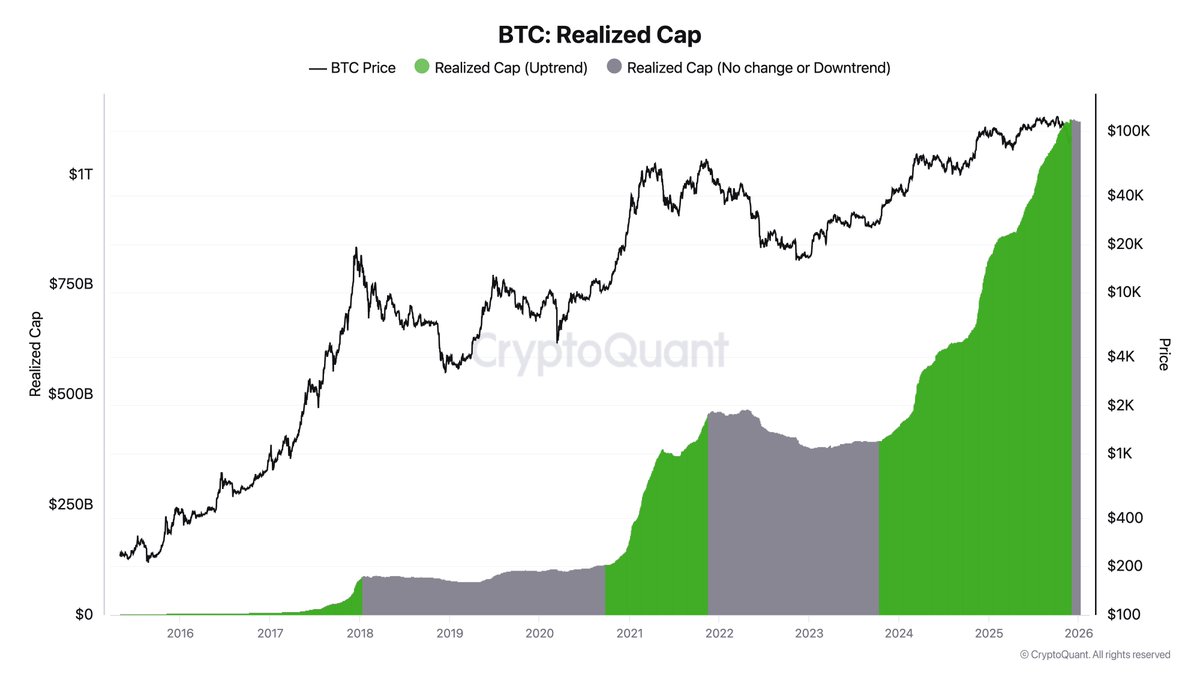
The chart shared by the analyst highlights Bitcoin’s Realized Cap, which continues to trend upward even as price momentum slows. Historically, an expanding realized cap reflects coins being absorbed at higher cost bases, signaling conviction among long-term holders rather than speculative churn.
Green phases on the chart correspond to periods when realized cap growth accelerates, while grey zones mark consolidation rather than distribution. The current structure shows realized cap near cycle highs, reinforcing the idea that Bitcoin is transitioning into a maturity phase defined by accumulation and balance-sheet holding, not rapid boom-and-bust dynamics.
Market Takeaway
Together, the commentary and on-chain data suggest a market that has cooled without breaking. Bitcoin appears to be digesting gains through time rather than price, with downside risks capped by institutional holding behavior. While upside catalysts may take longer to materialize, the probability of a violent collapse looks materially lower than in past cycles.
The post Bitcoin Capital Inflows Slow, But Crash Risks Fade, Says CryptoQuant Founder appeared first on ETHNews.
