
New Bitcoin whales are accumulating BTC faster than at any other point in the asset’s history, according to on-chain data tracking realized capitalization held by newly formed large holders. The chart highlights a sharp and accelerating expansion in capital controlled by these entities, even as Bitcoin’s price continues to consolidate near recent highs.
What the Chart Shows
The black line represents Bitcoin’s price, while the purple area tracks the realized cap attributed to new whales, large holders whose coins were acquired relatively recently rather than held since early cycles.
What stands out is the near-vertical rise in the realized cap curve over the most recent period. This indicates that a massive amount of capital has entered Bitcoin through new large buyers, rather than redistribution among long-term holders.
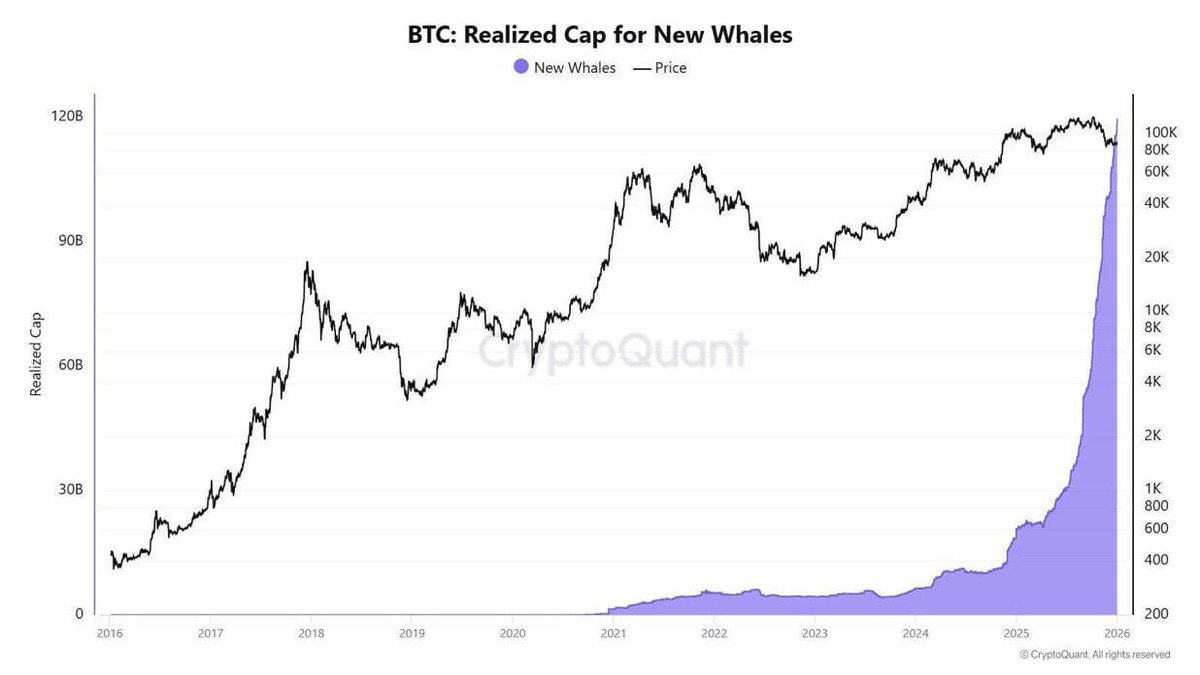
Unlike speculative spikes, realized cap increases only when coins move on-chain at higher prices. In other words, this reflects actual capital deployment, not leverage or derivatives activity.
New Whales, Different Behavior
Historically, whale accumulation has often occurred after deep drawdowns, when price was depressed and sentiment weak. This phase looks different.
New whales are accumulating:
- At elevated price levels
- During relatively low volatility
- Without evidence of panic or forced selling elsewhere
That combination suggests strategic positioning rather than short-term speculation. These buyers appear willing to absorb supply even as price trades near cycle highs, indicating confidence in higher long-term valuations.
Supply Dynamics Are Tightening
As new whales accumulate, liquid supply available on exchanges continues to shrink. When large entities remove coins from circulation and hold them, it reduces downside pressure and increases the sensitivity of price to future demand shocks.
This helps explain why pullbacks have remained relatively shallow despite elevated price levels. Sellers exist, but buyers with size are consistently absorbing supply.
Why This Matters for Market Structure
This type of accumulation phase often reshapes Bitcoin’s ownership base. When new, well-capitalized holders replace short-term sellers, the market typically transitions into a stronger structural foundation.
Importantly, this does not imply immediate upside. Historically, heavy whale accumulation often precedes:
- Periods of sideways consolidation
- Volatility compression
- Followed by directional expansion once supply becomes constrained
The Bigger Picture
The key takeaway from the chart is not speed alone, but scale. The realized cap held by new whales is rising faster than in prior cycles, even compared to 2020–2021.
That suggests Bitcoin is still undergoing institutional and high-net-worth absorption, not late-stage distribution.
Markets tend to turn not when everyone is bullish, but when the largest buyers quietly finish accumulating. This data suggests that process is very much underway.
The post Bitcoin Whales Are Accumulating at a Historic Pace: Here’s Why It Matters appeared first on ETHNews.
